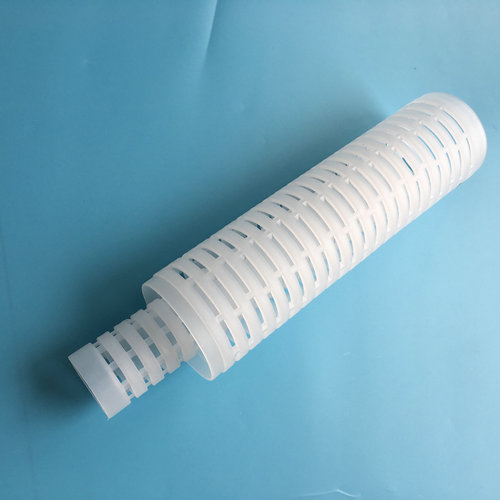
Inner Core and Outer Cage Production — The Backbone of Cartridge Integrity
Views : 3056
Author : indrofiltermachine.com
Update time : 2026-02-23 16:13:02
Inner Core and Outer Cage Production — The Backbone of Cartridge Integrity
In the world of industrial filtration, much attention is given to filter media efficiency, micron ratings, and contaminant retention performance. However, beneath every high-performing pleated filter cartridge lies two critical structural components that determine whether that performance can be sustained under pressure: the inner core and the outer cage.
These plastic support structures are far more than simple frameworks. They are the backbone of cartridge integrity, responsible for maintaining geometry, resisting pressure loads, protecting pleats, and ensuring long-term operational stability. Without precision-engineered inner cores and outer cages, even the highest-quality filtration media will fail prematurely.
This article explores the design principles, material selection, manufacturing technologies, structural challenges, and quality control standards behind inner core and outer cage production. 1. The Structural Role of the Inner Core
The inner core serves as the central support structure of a pleated filter cartridge. Positioned inside the pleated media cylinder, it primarily resists inward pressure forces during operation. Pressure Resistance and Collapse Prevention
During filtration, fluid flows from the outside of the cartridge inward (in most standard designs). As contaminants accumulate, differential pressure increases. This creates compressive force pushing the media toward the center.
The inner core must:
Prevent media collapse
Maintain open flow channels
Resist deformation under high differential pressure
Support long cartridges (20”, 30”, 40”) without bending
A poorly designed inner core can buckle, leading to reduced flow area or catastrophic collapse. Flow Optimization
Beyond mechanical strength, the inner core must allow smooth flow toward the outlet. Its rib pattern and perforation design influence:
Turbulence levels
Pressure drop
Flow distribution uniformity
Optimized rib geometry ensures that structural strength does not compromise hydraulic performance.
2. The Protective Function of the Outer Cage
The outer cage surrounds the pleated media and serves as protection against outward forces and handling damage. Radial Support
In high-flow systems or applications with flow reversal, pressure can act outward. The outer cage prevents:
Pleat ballooning
Media tearing
Structural distortion
Especially in high-flow filter designs, outer cage rigidity is essential to maintain pleat spacing and effective filtration area. Handling and Installation Protection
During shipping, installation, and maintenance, cartridges may experience mechanical stress. The outer cage:
Protects pleats from crushing
Maintains cylindrical geometry
Prevents deformation during insertion into housings
This protective role becomes even more critical for longer cartridges, where bending forces increase with length.
3. Material Selection: Engineering for Performance
Material choice is foundational in inner core and outer cage production. Common Materials Used
Most structural components are manufactured from high-performance thermoplastics such as:
Polypropylene (PP)
Reinforced polypropylene blends
Nylon (PA) for higher temperature applications
Glass-filled polymers for added rigidity
These materials are selected based on:
Chemical compatibility
Temperature resistance
Mechanical strength
Cost efficiency
For aggressive chemical environments, enhanced polymer formulations ensure resistance to swelling, cracking, or degradation. Balancing Strength and Flow
Material thickness must be optimized carefully. Overly thick walls:
Increase material cost
Restrict open area
Raise pressure drop
Too thin:
Risk collapse
Reduce long-term durability
Engineering design aims for the ideal balance between structural integrity and hydraulic efficiency.
4. Design Engineering of Inner Cores
Inner core design involves several critical parameters. Rib Pattern and Geometry
The rib structure determines compressive strength. Common designs include:
Vertical straight ribs
Spiral ribs
Diamond-pattern perforations
Reinforced cross-lattice structures
Each pattern offers different advantages in load distribution and flow dynamics. Open Area Ratio
Open area percentage affects:
Pressure drop
Flow capacity
Debris accumulation
Higher open area improves flow but reduces structural strength. Engineers use simulation tools to optimize this ratio. Length Reinforcement for Extended Cartridges
For 40” filters, axial reinforcement becomes crucial. Without proper design:
Core sagging may occur
Joint areas may weaken
Alignment issues can arise
Advanced production often includes reinforced rib junctions to prevent bending over long spans.
5. Design Engineering of Outer Cages
Outer cage design complements inner core engineering. Pleat Support Optimization
The outer cage must maintain pleat spacing. If spacing changes:
Filtration surface area decreases
Dirt holding capacity reduces
Pressure distribution becomes uneven
Uniform slot spacing ensures pleats remain evenly distributed across the entire cartridge length. Impact Resistance
Outer cages must absorb minor impacts without cracking. This is particularly important during:
Warehouse storage
Transport
Cartridge replacement
High-quality injection molding ensures toughness and dimensional stability.
6. Manufacturing Technologies
Precision manufacturing is essential to guarantee repeatability and reliability. Injection Molding
Most inner cores and outer cages are produced through high-precision injection molding.
Advantages include:
Tight dimensional tolerance
Consistent wall thickness
High production efficiency
Complex rib geometry capability
Modern injection molds are designed to reduce warping and shrinkage. Automated Cutting and Length Connecting
For 20”, 30”, or 40” cartridges, multiple molded sections may be joined using:
Thermal welding
Infrared fusion
Ultrasonic welding
Precise alignment fixtures ensure axial straightness during connection. Quality-Controlled Tooling
Tooling accuracy directly impacts final product quality. High-quality molds ensure:
Uniform perforation size
Consistent rib thickness
Minimal dimensional deviation
Regular mold maintenance prevents defects that could compromise cartridge integrity.
7. Structural Challenges in Production
Manufacturers face several challenges in producing high-integrity cores and cages. Warping and Shrinkage
Thermoplastics naturally shrink during cooling. Improper cooling control can cause:
Oval deformation
Misalignment
Reduced concentricity
Controlled temperature management and optimized mold design mitigate these risks. Alignment Precision
Concentricity between inner core, pleated media, and outer cage is critical. Misalignment can lead to:
Uneven pressure loading
Seal leakage
Reduced lifespan
Automated assembly systems improve alignment accuracy. Long-Term Fatigue Resistance
Repeated pressure cycles stress structural components. High-quality materials and rib geometry ensure resistance to fatigue cracking over extended service life.
8. Quality Control and Testing
To guarantee structural reliability, rigorous testing procedures are implemented. Dimensional Inspection
Key parameters include:
Outer diameter tolerance
Inner diameter consistency
Wall thickness uniformity
Straightness and roundness
Precision measurement tools ensure compatibility with industry-standard housings. Mechanical Testing
Testing may include:
Collapse pressure tests
Burst strength verification
Compression resistance evaluation
These tests confirm that both inner core and outer cage meet required performance thresholds. Chemical Compatibility Testing
Samples may be exposed to:
Acidic solutions
Alkaline solutions
Solvents
High-temperature fluids
This ensures structural components will not degrade under real-world conditions.
9. Integration with Pleated Media
Structural components must work seamlessly with pleated filtration media. Bonding Compatibility
Inner cores and outer cages must bond securely with:
Melt-blown media
Membrane media
Nonwoven materials
Material compatibility ensures strong adhesion during end-cap welding and assembly. Maintaining Pleat Geometry
Structural precision ensures:
Uniform pleat height
Stable filtration surface area
Balanced contaminant loading
Without proper support, pleat collapse can reduce effective filtration area by a significant margin.
10. Why Inner Core and Outer Cage Production Defines Cartridge Quality
While filtration media determines particle retention, structural components determine whether that performance can be maintained over time.
A well-produced inner core and outer cage provide:
Mechanical stability
Pressure resistance
Pleat protection
Dimensional accuracy
Long service life
Poorly engineered structures result in:
Premature collapse
Media distortion
Increased pressure drop
Unexpected system shutdown
In high-demand industrial applications, structural failure is not acceptable. Therefore, precision in core and cage production directly defines overall cartridge reliability.
Conclusion
Inner core and outer cage production is not a secondary process — it is the backbone of cartridge integrity. These structural elements ensure that pleated filter cartridges can withstand pressure, maintain geometry, protect media, and deliver stable filtration performance throughout their service life.
Through advanced material selection, optimized rib geometry, precision injection molding, and strict quality control, manufacturers can produce structural components that match the demands of modern industrial filtration systems.
As flow rates increase and filtration systems scale to 40” and beyond, the importance of strong, precisely engineered inner cores and outer cages becomes even more critical. Ultimately, a filter cartridge is only as strong as its backbone — and that backbone begins with expertly designed and manufactured structural components.