The global demand for high-performance filter cartridges continues to grow across industries such as water treatment, pharmaceuticals, food and beverage, chemicals, microelectronics, biotechnology, and industrial manufacturing. As filtration requirements become more demanding, manufacturers must improve not only the quality of their products but also the efficiency and consistency of their production processes.
One of the most critical stages in manufacturing a pleated filter cartridge is attaching the plastic end caps to the pleated filter element. The strength, precision, and integrity of this connection directly influence the cartridge’s filtration performance, pressure resistance, and service life. Poorly welded end caps can lead to fluid bypass, leakage, reduced filtration efficiency, and premature product failure.
To achieve consistent, high-quality production, many manufacturers are integrating automated end cap welding machines into complete filter cartridge assembly lines. These machines work seamlessly with pleating, cutting, seam welding, inspection, and packaging equipment, creating a streamlined manufacturing process capable of producing premium filter cartridges with excellent repeatability and productivity.
This article explores the importance of end cap welding, the benefits of integrating welding machines into automated assembly lines, and the technologies that support efficient, large-scale filter cartridge manufacturing.
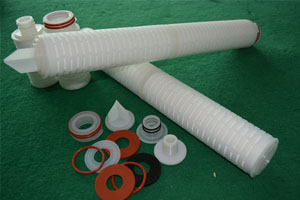
A pleated filter cartridge consists of several components assembled into a single filtration unit, including:
- Pleated filter media
- Inner support core
- Outer protective cage
- Plastic end caps
- Adapters
- O-rings or sealing gaskets
Among these components, the end caps serve several essential functions:
- Secure the filter media
- Seal the cartridge to prevent fluid bypass
- Provide structural support
- Connect the cartridge to the filtration housing
- Maintain pressure integrity during operation
A strong and uniform weld between the filter media and the end caps ensures that all process fluid passes through the filtration media rather than around it.
Although manual assembly may be suitable for small production volumes, it presents several limitations for modern manufacturing.
Common challenges include:
- Inconsistent weld quality
- Variable heating temperatures
- Uneven welding pressure
- Lower production efficiency
- Increased labor costs
- Higher reject rates
- Greater operator dependency
As customer expectations and quality standards continue to rise, manufacturers increasingly require automated solutions that minimize these variables.
Integrating end cap welding machines into a complete production line offers numerous operational and quality advantages.
Automated welding systems operate using precisely controlled parameters, including:
- Heating temperature
- Heating time
- Welding pressure
- Cooling time
- Positioning accuracy
Every cartridge is produced using the same process conditions, resulting in highly consistent weld quality.
Automated equipment significantly increases manufacturing capacity.
Compared with manual production, integrated welding systems provide:
- Faster production cycles
- Reduced handling time
- Continuous operation
- Lower downtime
- Increased daily output
This enables manufacturers to meet growing market demand without sacrificing quality.
Automation reduces several production expenses, including:
- Direct labor
- Material waste
- Product rework
- Equipment maintenance
- Quality inspection costs
Although automated systems require an initial investment, they often deliver substantial long-term savings through improved productivity and reduced defects.
A fully integrated assembly line combines multiple manufacturing processes into one efficient workflow.
Automatic media feeding systems ensure stable material supply while reducing manual handling.
The pleating machine creates uniform pleats that maximize filtration surface area.
Benefits include:
- Higher dirt-holding capacity
- Improved flow rates
- Lower pressure drop
- Longer cartridge service life
Automatic cutting machines produce filter media with accurate dimensions.
Precise cutting improves:
- Assembly accuracy
- Weld alignment
- Material utilization
- Production consistency
The pleated media is joined into a cylindrical filter element.
Reliable seam welding ensures:
- Structural strength
- Leak-free construction
- Stable cartridge geometry
The end cap welding station joins the filter media assembly to the plastic end caps.
Modern systems typically include:
- Automatic positioning
- Controlled heating
- Precise pressure control
- Cooling cycle management
- Automated unloading
This stage has a direct impact on cartridge sealing performance.
Some cartridge designs require additional adapters or connection fittings.
Automated adapter welding improves dimensional consistency while reducing assembly time.
Integrated testing stations verify product quality before packaging.
Typical tests include:
- Visual inspection
- Dimensional measurement
- Pressure testing
- Bubble point testing
- Flow rate testing
- Leak testing
Automatic packaging systems improve efficiency while protecting finished cartridges during transportation and storage.
Many manufacturers now choose non-contact infrared welding technology for end cap assembly.
Unlike conventional hot plate welding, infrared systems heat plastic surfaces without physical contact.
Advantages include:
- Uniform heat distribution
- Reduced material deformation
- Cleaner welding surfaces
- Improved weld appearance
- Strong molecular bonding
- Lower maintenance requirements
Advanced infrared heating systems equipped with water-cooling technology further improve temperature stability, ensuring consistent welding performance during continuous production. This design reduces overheating, minimizes material sticking, and delivers strong, leak-proof welds that meet the demanding requirements of industrial filtration applications.
Modern assembly lines increasingly incorporate intelligent control systems.
Programmable logic controllers (PLCs) and human-machine interfaces (HMIs) allow operators to monitor and adjust production parameters in real time.
Key process controls include:
- Heating temperature
- Welding duration
- Pressure settings
- Cooling cycles
- Production speed
- Alarm monitoring
- Data recording
These controls help ensure stable production while simplifying machine operation and troubleshooting.
Consistent product quality requires continuous monitoring at every production stage.
Important quality control procedures include:
Operators verify:
- Weld quality
- Pleat uniformity
- Surface cleanliness
- Component alignment
Leak testing confirms that the welded joints provide complete sealing without fluid bypass.
Pressure resistance testing evaluates structural integrity under operating conditions.
For membrane filter cartridges, bubble point testing verifies membrane integrity and sealing performance.
Flow testing confirms that the finished cartridge meets design specifications for pressure drop and throughput.
Comprehensive quality assurance minimizes product failures and increases customer confidence.
Integrated end cap welding machines support the production of filter cartridges used in numerous industries.
Filter cartridges protect reverse osmosis systems, ultrafiltration equipment, and municipal water treatment plants.
Reliable filtration ensures product quality during the processing of beverages, dairy products, edible oils, and bottled water.
Leak-proof cartridges are essential for sterile filtration and regulatory compliance.
Semiconductor manufacturing requires ultrapure water filtration with extremely high reliability.
Industrial chemical filtration demands durable cartridges capable of operating under challenging conditions.
Process filtration systems require mechanically strong cartridges with consistent sealing performance and long service life.
Manufacturing technology continues to evolve toward greater automation and digitalization.
Future developments include:
- AI-assisted production optimization
- Machine vision inspection
- Robotic cartridge handling
- Automatic quality classification
- Predictive equipment maintenance
- Digital production traceability
- Remote equipment monitoring
- Smart factory integration
These technologies improve manufacturing efficiency while maintaining exceptional product quality.
End cap welding plays a decisive role in the performance and reliability of pleated filter cartridges. Integrating automated end cap welding machines into complete filter cartridge assembly lines enables manufacturers to achieve consistent weld quality, higher productivity, lower operating costs, and improved product reliability.
By combining precision pleating, accurate cutting, reliable seam welding, advanced non-contact infrared end cap welding, intelligent process control, and comprehensive quality testing, modern production lines deliver filter cartridges that meet the demanding requirements of water treatment, pharmaceuticals, food and beverage, electronics, chemical processing, and many other industries.
As the filtration industry continues to demand greater efficiency, stricter quality standards, and higher production capacity, integrated assembly lines equipped with advanced end cap welding technology will remain essential for manufacturers seeking to produce leak-proof, high-performance filter cartridges that perform reliably in the world’s most demanding applications.