As filtration systems become increasingly critical across industries such as pharmaceuticals, food and beverage, microelectronics, water treatment, chemicals, and biotechnology, the demand for high-quality filter cartridges continues to rise. Modern filter cartridges must provide not only precise filtration efficiency but also exceptional structural integrity to ensure safe and reliable operation under demanding conditions.
One of the most important manufacturing processes that determines the performance of a pleated filter cartridge is the welding of its plastic end caps. A weak or inconsistent weld can create bypass channels, allowing unfiltered liquid or gas to pass through the cartridge. Even a microscopic leak may compromise product quality, reduce filtration efficiency, or lead to costly system failures.
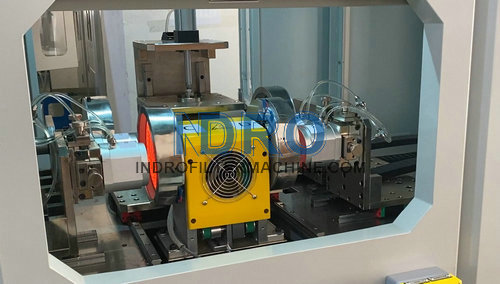
To overcome these challenges, manufacturers are increasingly adopting non-contact infrared (IR) welding technology. Unlike traditional hot plate welding, infrared welding heats plastic components without physical contact, resulting in cleaner welds, improved consistency, and stronger leak-proof seals. This advanced manufacturing process has become a preferred solution for producing premium pleated filter cartridges that meet the strict requirements of modern filtration applications.
A pleated filter cartridge consists of several components that must work together as a single sealed filtration unit. These components typically include:
- Pleated filter media
- Inner support core
- Outer protective cage
- Plastic end caps
- Adapters
- O-rings or sealing gaskets
The connection between the filter media and the end caps is particularly critical. During operation, all process fluid must pass through the filter media. If the end cap weld is defective, liquid or gas can bypass the filtration layer, allowing contaminants to enter the downstream process.
Leak-proof welding offers several important advantages:
- Ensures complete filtration integrity
- Eliminates bypass leakage
- Improves product reliability
- Extends cartridge service life
- Reduces customer complaints
- Supports compliance with strict industry standards
- Increases confidence in critical filtration applications
For industries where product purity is essential, such as pharmaceutical manufacturing or ultrapure water production, leak-free construction is not optional—it is a fundamental requirement.
Infrared welding is a thermal joining process that uses infrared radiation to heat plastic surfaces until they reach their melting temperature. Once the required temperature is achieved, the components are brought together under controlled pressure to create a strong molecular bond.
Unlike conventional hot plate welding, the heating source never touches the plastic components.
The basic welding process consists of four stages:
- Positioning the plastic components.
- Heating the joining surfaces with infrared radiation.
- Bringing the molten surfaces together under controlled pressure.
- Cooling the welded assembly while maintaining alignment.
Because there is no direct contact between the heating element and the plastic parts, contamination and surface damage are significantly reduced.
Since the heating element never touches the plastic, there is no material transfer or sticking during production.
This results in:
- Cleaner weld surfaces
- Reduced maintenance
- Longer equipment life
- Improved product appearance
Infrared radiation heats the welding surface evenly.
Uniform heating provides:
- Consistent melting depth
- Stable weld geometry
- Reduced internal stress
- Higher weld quality
This consistency is particularly important for large-diameter pleated filter cartridges.
Traditional contact heating may cause excessive pressure or localized overheating.
Infrared welding minimizes:
- Plastic distortion
- Warping
- Uneven melting
- Surface defects
The result is improved dimensional accuracy throughout the finished cartridge.
When both plastic surfaces are heated uniformly before joining, molecular fusion occurs across the entire welding interface.
This produces:
- High mechanical strength
- Excellent sealing performance
- Long-term durability
- Reliable leak resistance
Strong welds are especially important for cartridges operating under elevated pressure or frequent pressure fluctuations.
Although hot plate welding has been widely used for many years, infrared welding offers several significant improvements.
| Feature |
Traditional Hot Plate Welding |
Non-Contact Infrared Welding |
| Heating Method |
Direct contact |
Non-contact infrared radiation |
| Surface Cleanliness |
Material may stick to heating plate |
Clean heating process |
| Temperature Uniformity |
Moderate |
Excellent |
| Plastic Deformation |
Higher risk |
Significantly reduced |
| Weld Appearance |
May vary |
Consistent and clean |
| Maintenance |
Frequent cleaning required |
Lower maintenance requirements |
| Production Consistency |
Good |
Excellent |
For manufacturers seeking high-volume production with consistent quality, infrared welding offers clear advantages.
One of the latest innovations in infrared welding equipment is the integration of water-cooling technology.
During continuous production, infrared heating systems generate considerable thermal energy. Without effective temperature control, excessive heat may affect welding consistency.
Water-cooling systems provide several benefits:
- Stable operating temperatures
- Improved heating accuracy
- Reduced thermal drift
- Consistent welding cycles
- Extended equipment lifespan
- Better production repeatability
By maintaining optimal operating conditions, water-cooled infrared systems deliver reliable welding quality even during long production runs.
Modern filter cartridge manufacturing increasingly relies on automated production lines that integrate infrared welding with other precision processes.
A typical production line includes:
- Automatic filter media pleating
- Precision media cutting
- Center seam welding
- End cap infrared welding
- Adapter welding
- Visual inspection
- Quality testing
- Packaging
Automation improves production efficiency while ensuring every cartridge is manufactured according to identical process parameters.
This level of consistency is difficult to achieve through manual assembly.
Even with advanced welding technology, every filter cartridge should undergo comprehensive quality testing before shipment.
Common inspection procedures include:
Operators examine:
- Weld uniformity
- Surface finish
- Component alignment
- Overall appearance
The assembled cartridge is subjected to internal pressure to verify that no leakage occurs around the welded joints.
For membrane cartridges, bubble point testing confirms membrane integrity and proper sealing.
This test verifies that the cartridge can withstand pressures beyond normal operating conditions without structural failure.
Flow testing ensures the welded cartridge maintains the required filtration performance without excessive pressure loss.
These quality control procedures help ensure every cartridge meets customer specifications and industry standards.
Non-contact infrared welding technology is suitable for manufacturing filter cartridges used in a wide range of industries.
High-flow and pleated filter cartridges protect reverse osmosis systems and industrial water treatment equipment.
Leak-free cartridges ensure product purity during the filtration of beverages, dairy products, edible oils, and bottled water.
Sterile filtration requires perfectly sealed cartridges to maintain product safety and regulatory compliance.
Ultra-pure water systems used in semiconductor manufacturing depend on precision filter cartridges with zero bypass leakage.
Chemical plants require durable filter cartridges capable of withstanding aggressive fluids while maintaining reliable sealing performance.
As manufacturing technology continues to evolve, infrared welding systems are becoming increasingly intelligent and efficient.
Emerging developments include:
- AI-assisted process monitoring
- Real-time temperature feedback
- Automatic weld parameter optimization
- Machine vision quality inspection
- Predictive maintenance
- Energy-efficient infrared emitters
- Digital production traceability
- Smart manufacturing integration
These innovations will further improve production consistency while reducing manufacturing costs.
Leak-proof construction is one of the most critical quality requirements for modern pleated filter cartridges. The integrity of every welded joint directly affects filtration performance, product reliability, and customer confidence.
Non-contact infrared welding technology has transformed filter cartridge manufacturing by providing cleaner heating, uniform temperature distribution, stronger molecular bonding, and significantly improved production consistency. When combined with advanced water-cooling technology, automated assembly systems, and comprehensive quality control, infrared welding enables manufacturers to produce premium filter cartridges capable of meeting the demanding standards of water treatment, pharmaceutical, food and beverage, electronics, and chemical industries.
As filtration applications continue to require higher performance and greater reliability, manufacturers that invest in advanced non-contact infrared welding technology will be better positioned to produce leak-proof filter cartridges with consistent quality, longer service life, and superior customer satisfaction. This innovative welding process is not only improving manufacturing efficiency but also helping define the next generation of high-performance filtration products.